What is an AI Chatbot & How It Helps Your E-shop Sell
Every visitor who lands on your e-shop and leaves without buying is a lost sale. Often they don’t leave because the product wasn’t interesting — they leave because they had a question that wasn’t answered at the moment it mattered. This is exactly where an AI chatbot comes in: an assistant that replies instantly, guides shoppers to the right product and keeps the customer inside the buying journey. In this article we explain what it is, how it works and — above all — how it translates into more sales, backed by research data.
What is an AI chatbot
An AI chatbot is a program that talks to your visitors in natural language, through a chat window on your site. Unlike the old “rule-based” bots — which followed predefined buttons and “got stuck” at the first unexpected question — modern AI chatbots are built on large language models (LLMs). They understand the user’s intent, even if they write in slang or with typos, and answer based on your own store’s content (products, policies, guides).
The essential difference is that an AI chatbot doesn’t “read a script” — it composes an answer. That means it can serve the customer the way a good salesperson would: by asking, clarifying and recommending, instead of sending them off to a static FAQ.
The problem: where an e-shop loses sales
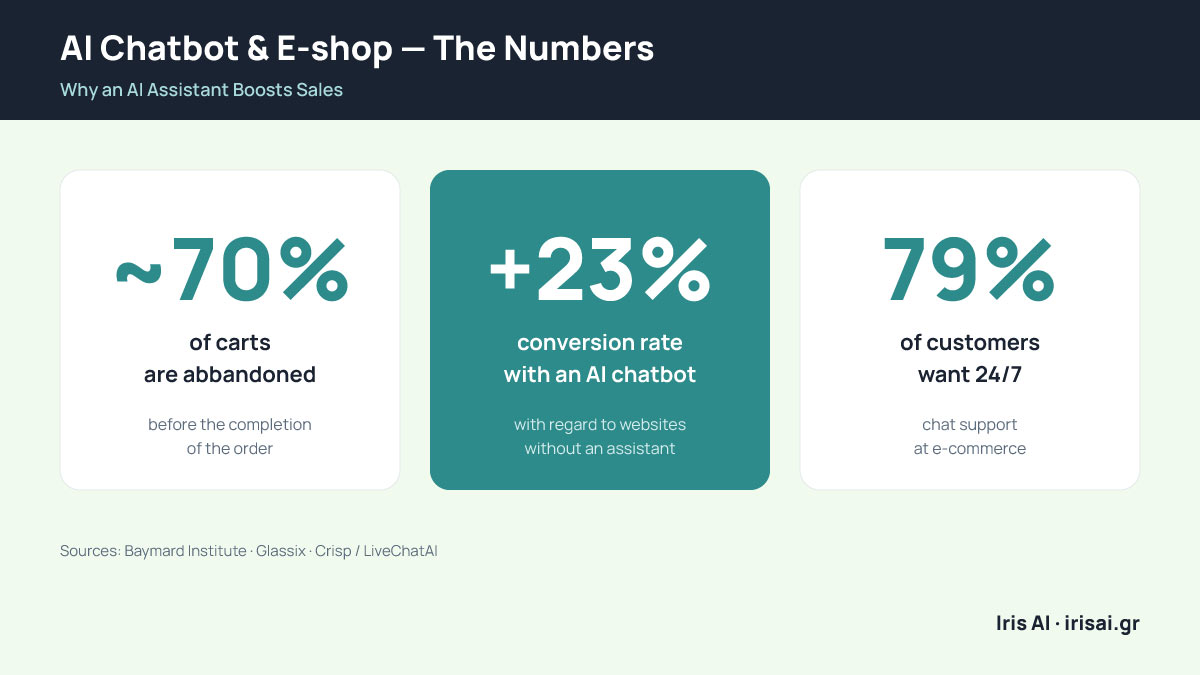
The first major “bleeding” point is cart abandonment. On average, roughly 70% of shopping carts are abandoned before the order is completed — meaning for every 100 customers who add a product to their cart, only ~30 actually buy. (Source: [1])
The reasons are often “solvable” with a timely answer. Nearly half of consumers (about 48%) abandon because the extra costs (shipping, taxes, fees) were higher than expected — a doubt an assistant can clear up on the spot, for example by mentioning the free-shipping threshold. (Source: [1])
The second point is timing and hours. Customers today expect an instant answer: roughly 76% of consumers expect an immediate response from a live chat, while the average actual response time is close to three minutes — three times slower than what they consider acceptable. (Source: [2])
And because purchases happen around the clock, the need doesn’t stop at store hours: about 79% of customers want 24/7 chat support, especially in e-commerce, and 85% expect to see a live chat widget when they visit a site. (Source: [2])
How an AI chatbot increases sales
1. It answers instantly, around the clock
The most immediate effect is that no customer is left unanswered. An AI chatbot replies in seconds — at night, on weekends and on holidays, exactly when there’s no one to pick up the phone. Given that customers who get a quick resolution are 2.4 times more likely to keep doing business with a company, speed isn’t a “nice-to-have” — it’s a revenue driver. (Source: [2])
2. It guides shoppers to the right product (like a salesperson)
A good AI chatbot doesn’t wait passively; it asks targeted questions and recommends the right product for each need. That is essentially personalized recommendation, and personalization has measurable value: according to McKinsey, it typically drives a 5–15% revenue increase, while smart product recommendations can lift conversion rate by up to 300%. (Source: [3])
3. It reduces cart abandonment
By resolving on the spot the doubts that lead to abandonment — shipping, delivery time, return policy, availability — the chatbot keeps the customer in the buying flow. Studies show that sites with an AI chatbot saw a 23% increase in conversion compared to those without one, while issues are also resolved 18% faster with a 71% success rate. (Source: [4])
4. It turns conversations into leads
When the customer isn’t ready to buy or wants something specialized (e.g. a bulk quote), a properly set-up chatbot collects their details as a lead and sends them to the business — instead of letting the visitor leave for good. This way, even “out-of-purchase” conversations gain commercial value.
5. It frees your team from the repetitive stuff
A large share of questions in an e-shop are repetitive: “when will my order arrive?”, “how do I make a return?”, “do you have this in another size?”. The chatbot answers these automatically, leaving your staff to handle the complex cases. It’s no coincidence that 62% of consumers prefer talking to a chatbot rather than waiting for a representative. (Source: [5])
AI chatbot vs the old “button-based chatbot”
Many people have had a bad experience with old bots that kept replying “I didn’t understand.” The difference with a modern AI chatbot is qualitative: it understands free-form language, keeps the thread of the conversation and relies on the store’s real content instead of prefabricated answers. In practice that means fewer dead ends and more completed interactions — the quality of the underlying AI model is what makes the difference between an assistant that sells and one that annoys.
For the Greek market this matters even more: the model has to handle Greek correctly — syntax, slang, even spelling mistakes — so it doesn’t give awkward answers that cost you the customer’s trust.
Legality (GDPR)
An AI chatbot processes communication with customers, so compliance with the GDPR and Greek Law 4624/2019 is essential. Solutions that work “stateless” — that is, they reply in real time without storing conversation content — keep the data-protection picture clean, while collecting only the details a customer voluntarily leaves as a lead. It’s a point worth checking before you choose a provider.
How to get started in practice
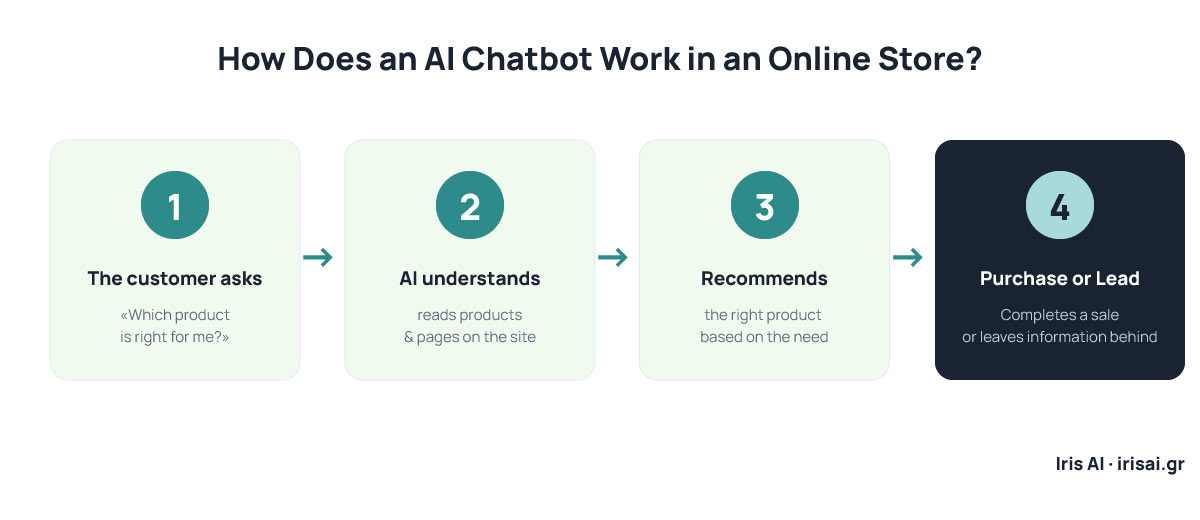
You don’t need to become a techie. The steps are simple: (1) pick a provider that supports your platform (e.g. WooCommerce), (2) connect the chatbot so it can “read” your products and pages, (3) customize the name, colors and tone to your brand, and (4) let it work, monitoring conversations and leads. With managed solutions, the entire technical side (hosting, AI, updates) is handled for you.
Iris AI is exactly that: a managed AI assistant for Greek WooCommerce e-shops that answers 24/7, recommends products and captures leads — with a top-tier AI model and no hidden charges. You can see it live at irisai.gr.
Conclusion
An AI chatbot isn’t a “gadget” — it’s a salesperson that works non-stop. It answers the moment the customer has a question, guides them to the right product, reduces cart abandonment and turns visitors into customers or leads. With data showing conversion increases on the order of 23% and up to 300% from smart recommendations, the question is no longer “if” but “when” you’ll add one to your e-shop.
Frequently Asked Questions (FAQ)
What is an AI chatbot? It’s a digital assistant that talks to a site’s visitors in natural language. Unlike old button-based bots, it’s built on modern artificial-intelligence models, understands free-form language and answers based on the store’s content.
How does it help an e-shop sell more? It answers instantly 24/7, guides the customer to the right product and resolves doubts on the spot (shipping, returns, availability) that lead to cart abandonment. Studies show conversion increases of up to 23%, while smart product recommendations can lift conversion by up to 300%.
Does it work properly in Greek? Yes, as long as it uses a high-quality language model. Quality in Greek (syntax, everyday speech, even spelling mistakes) is what separates an assistant that sells from one that annoys.
Is it GDPR-compliant? It can be fully compliant. Solutions that work stateless — replying in real time without storing conversation content — keep the data-protection picture clean, in line with the GDPR and Greek Law 4624/2019.
How quickly does it get set up? With a managed solution, the assistant can go live on your e-shop with no coding: connecting to the platform (e.g. WooCommerce), automatically reading products and pages, and adapting to your brand — often within a single day.
References
- Baymard Institute — Cart Abandonment Rate Statistics (average abandonment rate ~70.19%; 48% due to extra costs). https://baymard.com/lists/cart-abandonment-rate
- Crisp & LiveChatAI — 24/7 Support & Customer Response Time Benchmarks (76% expect an instant answer, 79% want 24/7 chat, 85% expect a live chat widget, 2.4× likelihood of staying with a quick resolution). https://crisp.chat/en/blog/ai-support-chatbot-benchmark/ · https://livechatai.com/blog/customer-support-response-time-statistics
- McKinsey & Company — The future of personalization (5–15% revenue increase from personalization; up to 300% conversion from product recommendations). https://www.mckinsey.com/capabilities/growth-marketing-and-sales/our-insights/the-future-of-personalization-and-how-to-get-ready-for-it
- Glassix — Study: AI Chatbots Enhance Conversions and Resolve Issues Faster (+23% conversion, 18% faster resolution, 71% success). https://www.glassix.com/article/study-shows-ai-chatbots-enhance-conversions-and-resolve-issues-faster
- Amra & Elma — AI Chatbot Conversion Rate Statistics (62% prefer a chatbot over waiting for a representative). https://www.amraandelma.com/ai-chatbot-conversion-rate-statistics/